Monday, August 28, 2006

Never Again!

[The following article first appeared in the Roanoke Times August 17, 2006.]

A Media Lap Dog No Longer
Jerry Fuhrman
The New York Times recently revealed in a front page article ("Partisan divide on Iraq exceeds split on Vietnam," July 30) the results of a study that showed more polarization exists today with regard to opinions on the war in Iraq than existed at the time of the Vietnam War:
"No military conflict in modern times has divided Americans on partisan lines more than the war in Iraq, scholars and pollsters say -- not even Vietnam. And those divisions are likely to intensify in what is expected to be a contentious fall election campaign."
The reason for this is simple. Unlike the turbulent days of Vietnam, in which the opinions expressed on network news shows held sway over the populace, much of America today relies on an array of alternative sources for news. And we are the better for it.

When Walter Cronkite declared in 1968 that the Vietnam War was "mired in stalemate" and couldn't be won, people's resolve was profoundly shaken. The former CBS News anchorman is now credited with having nearly single-handedly turned America against the war and to have brought it to an end. He deserves that credit.

Many of us on the right learned a valuable lesson from Vietnam, the offshoot of which is that it is because of Cronkite and others like him that those alternative news sources exist today. In the '60s, we were witness to nightly bouts of anguish and remorse displayed on the evening news over the pain and suffering inflicted by American military personnel upon innocent women and children in villages and hamlets seemingly throughout Vietnam -- North and South. And we subsequently learned that all the anguish was completely phony.

As soon as we retreated, Cronkite and his ilk on the left turned their backs on our allies there and the real slaughter began -- in South Vietnam in 1975 when wholesale executions of North Vietnam's former foes began, and, at the same time, in Pol Pot's Cambodia, where the killing fields were sown with the corpses of up to 3 million innocent people. Little was said about it on the evening news. Cronkite, et al, had moved on to Watergate and more enticing matters. Many of us learned not to trust these people ever again. We came to know them for what they are -- pretenders.

So, when President Bush appeared before a joint session of Congress 10 days after 9/11 and said, "Americans should not expect one battle, but a lengthy campaign unlike any other we have ever seen. It may include dramatic strikes visible on TV and covert operations secret even in success," we took these words to heart, steeled our resolve, prepared for that long, protracted conflagration that was forced upon us by a fanatical foe, cheered our loved ones who volunteered by the thousands to enter into harm's way in order to make us safe here at home, and vowed to stay the course.

And we expected no help from the left.

What we expected we have gotten. More stories of pain and suffering. More complaints of brutality. At the same time that accounts of buses carrying school children in Jerusalem being blown up gain only passing comment, a report of prisoners in Baghdad being forced to wear panties on their heads is condemned ad nauseam. A Koran supposedly being flushed down a toilet in an American prison gets far more air time than does the cold-blooded execution of four Americans in the streets of Fallujah.

They expect us to take them seriously. We did indeed learn from Vietnam -- and its aftermath. We learned the slogan taken up by Jews after the Holocaust: Never again! And we took to heart and live by the powerful words of Abraham Lincoln spoken at a time when another great struggle was under way, one that was taking a far more grievous toll: "We shall nobly save, or meanly lose, the last best hope of Earth."

We resolve to maintain the world's last best hope in part because these pretenders won't. So we find ourselves with this great divide between the attitudes of Americans on the left and those of us on the right. We expected it. We accept it. We celebrate it.

As for Vietnam -- Never again.

Tuesday, August 22, 2006

Letters In The Attic

Harold Fuhrman, my father, served in the 327th Infantry Regiment, 101st Airborne Division in World War II. He participated in the D-Day invasion of Normandy, was captured by the Germans, spent months in prisoner-of-war camps, and was eventually liberated by the Russians. He returned home to Bowler, Wisconsin emaciated and in poor health in the spring of 1945.

It was thought towards the end of the war that the Nazis would retreat into the Bavarian Alps and would wage guerilla war from there after the German army was finally defeated. Because of that, the 101st Airborne was transferred to Berchtesgaden, where Adolf Hitler had his palatial mountain retreat, with the intention of taking on the remnants of Hitler's fanatical SS.

This letter was written by a soldier in the 101st to Harold from there. Adolf Hitler had committed suicide just a few weeks before and the German army had surrendered on May 7. When the letter was written, the war in Europe was ended but the war against Japan would still rage for another three months.

The letter is typed, double-spaced, on standard size lined paper. Being 61 years old, the paper is aged, faded, and in poor condition. The identity of the author, K. Dunbar, is unknown but since Harold had worked on Division HQ staff and Dunbar obviously knew him well, and the fact that he had access to a typewriter, leads one to believe that Dunbar too worked at Division HQ.

I found the letter among my father's possessions after he died. In reproducing it here, I corrected a few typos for the sake of clarity.

26 May 1945
Berchtesgaden, Ger.
Dear Harold:

I certainly was glad to read your letter and learn that you were home. Also that both you and Gamble [in combat Harold operated a bazooka; Gamble was his loader and was captured at the same time] came through O.K. I hardly know what to say to you and I hope that you get used to being a civilian before too long. Do you think that you will be discharged before too long? I sure hope that we can get back to the states before too long. 

We received notification from the War Department that both you and Gamble had returned to Military Control and we knew that you had been liberated by someone but we didn't know exactly who. As some of the other boys that are writing and telling you that we are down here in Berchtesgaden, Germany. Hitler's and Goering's old hideout. I sure wish that you could see this place. Those bastards weren't hurting for anything.

They will also tell you that Tom Doyle was captured up in Bastogne and so far we haven't heard anything about him. Herb Beck who was also captured is in a hospital in France trying to put some weight back on. In the three months that he was captured he lost 58 lbs. and when one of the boys saw him they said that he really looked bad. I sure hope that Tom comes through all right. J.J. Stevens gets letters from his sister but they haven't heard anything about him. Well I guess that I had better close for now ... So here's hoping that you enjoy a wonderful stay while you are home and God bless you.
K. Dunbar

Monday, August 21, 2006

A Failing Plan

[The following article first appeared in the Roanoke Times August 11, 2006.]

The Plan For Southwest Virginia Is Failing
Jerry Fuhrman

In a recent conference call with one of Virginia’s most powerful politicians, I asked how he thought the dismal situation in Southwest Virginia could be turned around. I wanted to know what could be done to counter the sweeping and devastating manufacturing job losses that have occurred, how he might deal with our coal counties that are losing population, and about our stagnant economy. His answer? “Tourism.”

Tourism.

Another politician who has no answers, no new ideas, so he falls back on the default position learned from and perfected by a long line of politicians past and present. Southwest Virginia has nothing going for it save some rocks and bushes so we need to promote what little we have in the forlorn hope that we can lure northerners down here and partake of our scenic splendor, and while doing so, try to get them to purchase a hot dog and a bottled water at the local gas station. That, friends, is the plan for our future success.

It certainly can be said that we have what can be considered a scenic – some might say rugged and inhospitable - landscape. And with it – because of it – we are burdened with a weak transportation infrastructure. To make matters worse, we have substandard schools. And a very low-tech environment with predominantly unskilled labor. And in the areas where we were traditionally strongest, we now have foreign competition. And in parts of the region, we are in the throes of depopulation, particularly when it comes to our best and brightest young people who routinely move out of the area in order to be able to make a future for themselves. Yes, we have our hurdles.

But, by God, we’ve got trees too. And boulders. Lots of pretty rock formations. And lizards and snakes and such. So our future, according to those we look to for guidance in such matters, depends on enticing tourists to the area to walk among nature’s wonders. Or some such. 

Wednesday, August 16, 2006

Not a Bad Day On The Mountain

It's a good day I think when you get a mention on CBSNews.com and in the Washington Post.

My guess is neither link will be active very long so check these out while you can:
  • Melissa McNamara with CBSNews.com picked up my post from Saturday regarding Al Gore's hypocritical global heating lifestyle in "Gore Full Of Hot Air?".
and:
  • Chris Edwards with the Washington Post links to a post I had on Sunday with regard to the disparity in wages between the Washington DC area and the rest of Virginia in "Federal Pay: Myth and Realities."
As for Ms. McNamara, not only does she write well (although I really must simplify the spelling of my last name), I want to give birth to her next child. Check out the accompanying photo; you'll see what I mean.

And don't anyone write me about my having been very critical in the past of CBS News. That's all now changed. A kind word from a good lookin' reporter/producer and I'm a changed man.

Thursday, August 10, 2006

'Into The Mouth Of Hell'

As many of my regular readers know, I've been pretty tough on the Roanoke Times editorial staff in the past. You also know why. It's made up of a motley collection of leftist lunatics who write crap most Southwest Virginians can't comprehend or relate to.

Well. I'm here to report that I've now met most of them and found them to be a rather nice bunch. Still lefties and still looneys but nice just the same.

I bring this up because I am now one of them ... sorta. Beginning today and for the foreseeable future, you'll find once a week a column written by me for the Times. It will appear every Thursday and you can find it in the Op-Ed Commentary section of the paper. As you might expect, the first column is about Southwest Virginia and our ... burgeoning ... tourism industry. You can access it here:

http://www.roanoke.com/editorials/commentary/wb/77493

I generally hold liberals in low regard, considering most of them to be today's version of the 50's John Birch Society - with a twist. But I will give the editorial page editor of the Times, Dan Radmacher, credit for this. Despite the fact that I've gone after him on more than one occasion on the pages of this weblog, ridiculing some of his leftist nonsense, he invited me to bring the discussion to his page of the Times. He certainly didn't have to do that.

Such open-mindedness from a flaming leftist I'm not used to, but he's to be thanked - and commended for it.

So, I'm going to take this opportunity to change the way people view the Roanoke Times, one subscriber at a time. And when I've been able to wean them all from their (perceived) dependency on big government and their naive notions that we don't live in a hostile world and their twisted belief that George W. Bush is the great satan, I'll then work on the editorial staff.

A tougher row to hoe.

Anyway, I hereby thank Dan for the opportunity to bring to the readers of the Roanoke Times a different perspective (one held by most Americans, ahem), a conservative perspective, a Southwest Virginia perspective.

Believe me, in discussions with Mr. Radmacher, I've warned him about what's going to happen. Some of his readers are not going to like that which they are going to read. The namby-pamby limp-wristed Democrat types. I told him that it may reflect on him. And will without doubt come down on him. He accepts it (poor fool) and welcomes the dialogue that will ensue.

I just hope they don't kill him.

Saturday, July 29, 2006

Beating The Odds

Something for you to consider:

I took a stats course in graduate school that was taught by the manager of General Motors' seat belt division in Detroit (you're asking - a statistician was in charge of seat belt design and manufacture? Yes. He was there to calculate failure rates, which there always will be, no matter how safe they become. Six sigma and all that.).

Anyway, I remember him asking the following question of his students one day:

If you were to take all the different kinds of gaming in Las Vegas - roulette, slots, craps, blackjack, etc. - rolled them together and calculated the odds of a person winning, what percentage of the time would a person beat the house and come away a winner?

Answers ranged from 1% to 10%.

In fact, your chances of winning are 49.5%. Nearly every other time you sit down to gamble, odds are you're going to come away with some extra cash. Nearly being the key word. It is that 0.5% that makes Las Vegas rich. If you think about it, if the odds were remote, you'd never come back for more. It only makes sense.

That being the case, I'm here to tell you I beat the odds this week in my four fun-filled days in Atlantic City. I broke even. I didn't bet a dime.

So I came out 0.5% ahead of the casinos. And spent the money on beer. I was a winner all the way around.

My Kinda Hotel

I rolled into Richmond yesterday morning at 2:00 am, was checked in by 2:05, and was in bed at 2:09.

Holiday Inn Express indeed.

Thursday, July 27, 2006

Atlantic City

Well, I've been in Atlantic City for the last several days and I must tell you it's not my kind of vacation spot. Besides the fact that I seem to have found myself here at a point in time when dead mussels litter the beach - and stink up the boardwalk and surrounding countryside in front of the Hilton - there is also a certain other-worldliness to this town.

Buses roll in throughout the day, many of them originating in New York City, and they disgorge their passengers - the preponderance of which are very old; some even feeble - at the casinos. Thousands of elderly people can be found sitting in front of the slot machines at the various facilities around town with a surreal indifference in their expressions. They play. They lose. They go home. Hard to tell if they're actually enjoying it.

But they show up each day by the nursery home-load. So they must find some kind of pitiful satisfaction in their experiences.

Then I could mention the adventure it is to head out of the downtown area to find a nice restaurant at night, one in a location where you won't get your head handed to you.

But I'll not go there ...

Tuesday, July 25, 2006

It Don't Get Better Than This

I'm in a room on the 10th floor of the Hilton overlooking the (dark) Atlantic this morning. I had the opportunity yesterday to meet up with a business associate in Virginia Beach and we drove from there across the Chesapeake Bay (no we didn't have a Cuban floating car; we crossed the Chesapeake Bay Bridge-Tunnel) to Lewes, Delaware, where we caught the car ferry and crossed the Delaware Bay to Cape May, New Jersey.

Great day. Calm seas. Lots of jelly fish ...

And to think - I get paid for this.

Tuesday, July 11, 2006

Three Red Marbles

A story:

Babs Miller was bagging some early potatoes for me. I noticed, as I waited, a small boy, delicate of bone and feature, ragged but clean, hungrily apprising a basket of freshly picked green peas.

I paid for my potatoes but was also drawn to the display of fresh green peas. I am a pushover for creamed peas and new potatoes. Pondering the peas, I couldn't help overhearing the conversation between Mr. Miller and the ragged boy next to me.

"Hello Barry, how are you today?"

"H'lo, Mr. Miller. Fine, thank ya. Jus' admirin' them peas. Sure look good."

"They are good, Barry. How's your Ma?"

"Fine. Gittin' stronger alla' time."

"Good. Anything I can help you with?"

"No, Sir. Jus' admirin' them peas."

"Would you like to take some home?"

"No, Sir. Got nuthin' to pay for 'em with."

"Well, what have you to trade me for some of those peas?"

"All I got's my prize marble here."

"Is that right? Let me see it."

"Here 'tis. She's a dandy."

"I can see that. Hmmmmm, only thing is this one is blue and I sort of go for red. Do you have a red one like this at home?"

"Not zackley. but almost."

"Tell you what. Take this sack of peas home with you and next trip this way let me look at that red marble."

"Sure will. Thanks Mr. Miller."

Mrs. Miller, who had been standing nearby, came over to help me. With a smile she said, "There are two other boys like him in our community, all three are in very poor circumstances. Jim just loves to bargain with them for peas, apples, tomatoes, or whatever. When they come back with their red marbles, and they always do, he decides he doesn't like red after all and he sends them home with a bag of produce for a green marble or an orange one, perhaps."

I left the stand smiling to myself, impressed with this man.

A short time later I moved to Colorado but I never forgot the story of this man, the boys, and their bartering.

Several years went by, each more rapid that the previous one.

Just recently I had occasion to visit some old friends in that Idaho community and while I was there learned that Mr. Miller had died. They were having his viewing that evening and knowing my friends wanted to go, I agreed to accompany them.

Upon arrival at the mortuary we fell into line to meet the relatives of the deceased and to offer whatever words of comfort we could. Ahead of us in line were three young men. One was in an army uniform and the other two wore nice haircuts, dark suits and white shirts, all very professional looking.

They approached Mrs. Miller, standing composed and smiling by her husband's casket. Each of the young men hugged her, kissed her on the cheek, spoke briefly with her and moved on to the casket. Her misty light blue eyes followed them as, one by one, each young man stopped briefly and placed his own warm hand over the cold pale hand in the casket. Each left the mortuary awkwardly, wiping his eyes.

Our turn came to meet Mrs. Miller. I told her who I was and mentioned the story she had told me about the marbles. With her eyes glistening, she took my hand and led me to the casket.

"Those three young men who just left were the boys I told you about. They just told me how they appreciated the things Jim "traded" them. Now, at last, when Jim could not change his mind about color or size, they came to pay their debt."

"We've never had a great deal of the wealth of this world," she confided, "but right now, Jim would consider himself the richest man in Idaho ." With loving gentleness she lifted the lifeless fingers of her deceased husband. Resting underneath were three exquisitely shined red marbles.

Author unknown

Tuesday, June 27, 2006

A Tale Of Two Virginias

No, I'm not thinking of our wayward western counties that decided in 1863 to go their own way and (misguidedly) form their own state. I'm thinking of the cavernous expanse that today separates northern Virginia from southern Virginia.

Up north, the issues of the day relate to employers and how the planners up there might be able to stack one on top of another. Smart growth, mass transit, alternative fuels and such are the big topics of discussion.

Down here, our big issues relate to employers and how we might gain a few. To hold on to the few we have. We talk too about improving the quality of a woefully inadequate public education system. About improving the quality of the drinking water. In Southwest Virginia we talk - in 2006 - about putting sewer systems into communities that have never had them.

There is certainly talk in some circles about the needed completion of the Coalfields Expressway and about much-needed improvements being made to U.S. Route 58. Some say I-81 down this way needs to be upgraded. And that's all, in the big scheme of things, probably important. But generally, transportation issues aren't uppermost in the thoughts and discussions of folks around here.

Paychecks are. Food. Clothing. Shelter. The kinds of things taken for granted in the fabulously prosperous north. And there are issues here that people in the D.C. suburbs rarely talk about: Grievous suicide rates; Drinking water unfit for human consumption; Depopulation. Small communities decimated by the loss of thousands of jobs.

With this in mind, I think the recently announced proposal put forth by the Republicans in the Virginia House of Delegates to solve northern Virginia's transportation problem is a swell idea:
GOP Plan Would Raise N.Va. Taxes for Area RoadsBy Michael D. Shear and Rosalind S. Helderman, Washington Post Staff Writers
RICHMOND, June 26 -- People who live or work in Northern Virginia would pay steep new fees and higher taxes under a $578 million transportation plan being circulated by six Republican delegates from the region.


Having voted for months to block statewide tax increases that were pushed by Gov. Timothy M. Kaine (D) and the Republican-controlled Senate, the House members said their constituents will gladly pay more as long as the money raised is used only for road and rail projects in their area. (
link)
You folks up north feel your transportation system is inadequate? Fix it.

It's not that we want to do what our western counties did in 1863 and walk away from our troubles. We here in southern Virginia - particularly those of us in Southwest Virginia - simply need to solve our problems and work to bring our way of life into the 20th century - before we assist you in taking yours into the 22nd.

So. You all go along and take care of yourselves. You certainly have the means. We'll be along directly and will be happy to pitch in and help.

But first we have problems of our own that need fixing. Starting with the turds floating in the drinking water in Callahan Creek.

Monday, June 19, 2006

On Tourism - A Firsthand Report

It was recently reported that 9th District Congressman Rick Boucher (D-Abingdon, VA) took the plunge and recited the marriage vows with his new bride as they stood astride the Virginia Creeper Trail here in Southwest Virginia. Not my idea of sanctity but who am I to judge. I'm Lutheran; he's Methodist.

Buried in the press blurbage about the wedding was a statistic. According to those who have need of the Virginia Creeper trail being considered a good federal tax dollar investment (a huge investment), there are 200,000 visitors who walk or bike the trail annually. You'll also find that statistic cited on Boucher's never-ceasing campaign website:

Virginia Creeper Trail Wooden Trestle Improvement Project—Washington County
At Rick's urging, the federal government has provided $750,000 to perform repair and upgrade work on the trestles of the Virginia Creeper Trail between the Towns [sic] of Abingdon and Damascus. One of Southwest Virginia’s most popular tourism assets, the Virginia Creeper Trail is enjoyed by more than 200,000 visitors annually. (link)
When I first saw that stat, I scoffed. There's no way 200,000 people traverse that trail in a year's time.

Well, yesterday I had the chance to put Boucher's claim to the test - albeit in a very unscientific way. I sat in an open-air restaurant across from the trail in Damascus for an hour and counted people. Also, for the better part of the day, I drove the length of the trail, taking in the sights and enjoying a few unscripted hours with Paula.

Now, I need to give foundation to the study. End of Spring/beginning of Summer. Mid-afternoon. Perfect day (though a bit warm). A holiday weekend. Peak season.

Results: 10 hikers; 8 bicyclists. All afternoon.

There were, beyond these 18 souls, quite a few campers here and there and the road traffic going through Damascus was, at times, moderate.

But Gatlinburg it wasn't.

The small restaurant we stopped at (where we contributed to the local economy to the tune of $18) was doing a brisk business but nothing compared to say, the Dairy Queen here in Bland. We drove past the Old Mill restaurant and it looked to be nearly empty. As best I could tell, these were the only two "fine dining" establishments in town. I also stopped by Mount Rogers Outfitters and found myself to be the only customer there (at that point in time) talking to the only employee (or owner).

At one point Paula - as she was munching on what she deemed a fabulous chicken pita - mentioned that she thought there would be more people taking in the wonders of nature in beautiful Damascus on such a fine day.

But no. We weren't stepping over people in order to get to the trail or to the nearby riverbank. No wait in line at the restaurant.
Which gets us back to that 200,000 number. Does that reflect the number of people who walk or bike the trail AND who drive into/through town in a year's time? Does it include those who commute to town to work at the Dollar General each day? Has to. Because I can confidently say that at the peak of the season, the tourist traffic was sparse along the Virginia Creeper Trail in Damascus, Virginia on Fathers Day 2006.

Saturday, June 10, 2006

Martinsville Bloggers Conference


How about a blast from the past? Here's a photo taken in 2006 at a conference in Martinsville, Virginia in which I was included on a panel to discuss the then-burgeoning weblog medium. I was, at the time, regional sales manager for Oldcastle, Inc. and, at the same time, a columnist for the Roanoke Times.
Seated on the stage are (left to right): Me, Dan Radmacher, then-editorial page editor of the Times, Norm Leahy, who contributes to the Washington Post and a number of other publications, and Jeff Shapiro, a columnist for the Richmond Times-Dispatch.
The discussion essentially revolved around "old media" vs. "new media." That new media being the scourge of the dinosaur press - Facebook, Blogger, and a brand-new upstart - Twitter. The back-and-forth was a hoot.

- - - - - 

Ben Tribbett, Kat Wilton, Me, Alton Foley.
- - - - - -

An additional photo above.  The setting is the continental breakfast nook at the Hampton Inn in Martinsville. The time? The morning of the blogger's conference.

Seated with me at the table are Kat Wilton and respected Richmond Times-Dispatch columnist Jeff Schapiro.

The guy on the left with the big grin?  Democratic Party suck-up and Russell County Commonwealth's Attorney Brian Patton.  Note the fact that he sits alone.  Speaks volumes.
A day in the life ...

Tuesday, May 30, 2006

A Flood Of Memories

I once worked with this guy's (brief) venture here in the USA:
Daewoo founder sentenced to prison term 
By Bo-Mi Lim, Associated Press Writer

SEOUL, South Korea (AP) -- A Seoul court on Tuesday sentenced the founder and former chairman of collapsed conglomerate Daewoo to 10 years in prison for a range of charges including embezzlement and accounting fraud.

The Seoul Central District Court said it also ordered Kim Woo-choong, 69, to forfeit more than 21 trillion won ($22 billion) and pay a fine of 10 million won ($10,600).
Kim was indicted in June last year on charges of multi-trillion won accounting fraud, illegal financing and diverting funds out of the country. He was also accused of embezzlement and breach of trust. 
Daewoo U.S. was a screwed up company from the git-go (before GM bought the automotive division, the parent company was in debt to the tune of $50 billion) but I had great fun working with Daewoo executives in Compton, CA who tried their best to execute the nutty directives emanating from Seoul and from Chairman Kim.

Fond memories. Disheartening story. Important lessons learned.

Saturday, May 27, 2006

Today's Wisdom

Is it just me, or does anyone else find it amazing that our government can track a cow born in Canada almost three years ago, right to the stall where she sleeps in the state of Washington and they tracked her calves to their stalls? But they are unable to locate 11 million illegal aliens wandering around our country.

Maybe we should give them all a cow.

Author Unknown

Saturday, May 20, 2006

On Treasure And The History Tied To It

I made mention Thursday of a story that appeared in an Associated Press release of the treasure that was recently discovered above the ceiling tiles in an office in the Virginia state Capitol building during renovation.

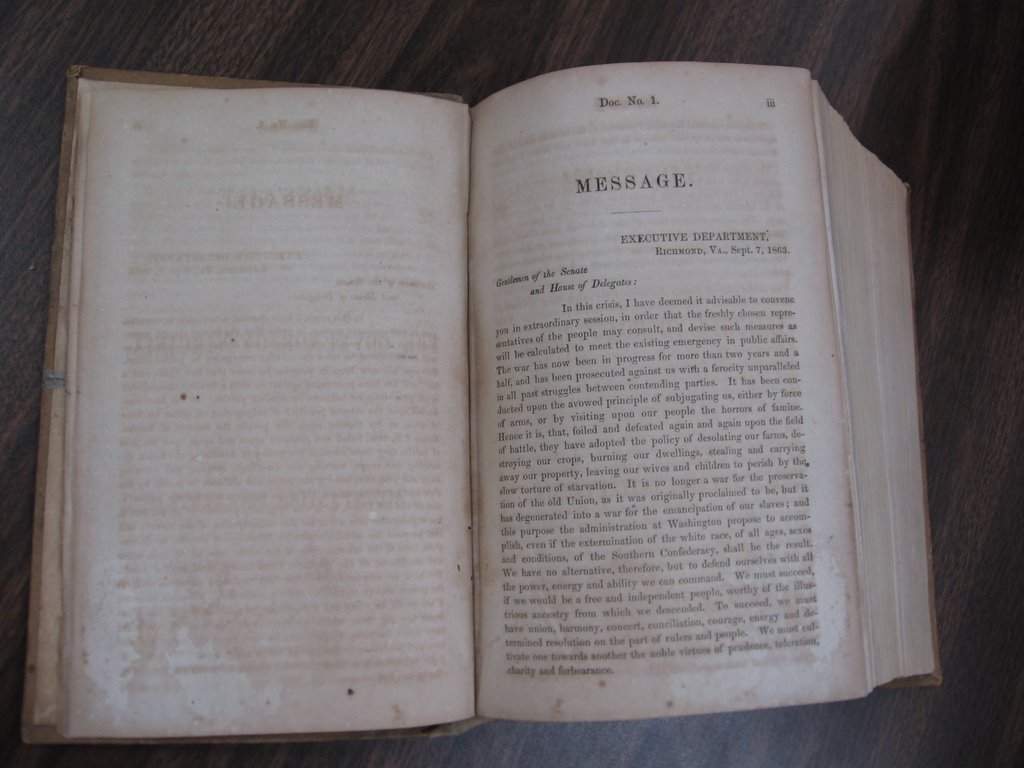
Through the magic - and the interactive nature - of the weblog, I quickly received an email from someone who had the opportunity to look over the documents that had been hidden all these many years and were just recently discovered. That person was kind enough to forward these pictures for all to see.

To refresh your memory, the AP writer, Bob Lewis, provided the following;


RICHMOND, Va. (AP) -- The construction dust inside Virginia's 18th century Capitol is still so thick, the stately House of Delegates chamber is barely discernible.

But from the mess and debris, hidden texts have emerged that afford a fresh glimpse into forgotten times - and the issues that dominated debate on Capitol Square.

The books and documents were discovered during the ongoing $99 million foundation-to-roof makeover of Virginia's 200-year-old Capitol, said Richard F. Sliwoski, who is overseeing the project for the Department of General Services.
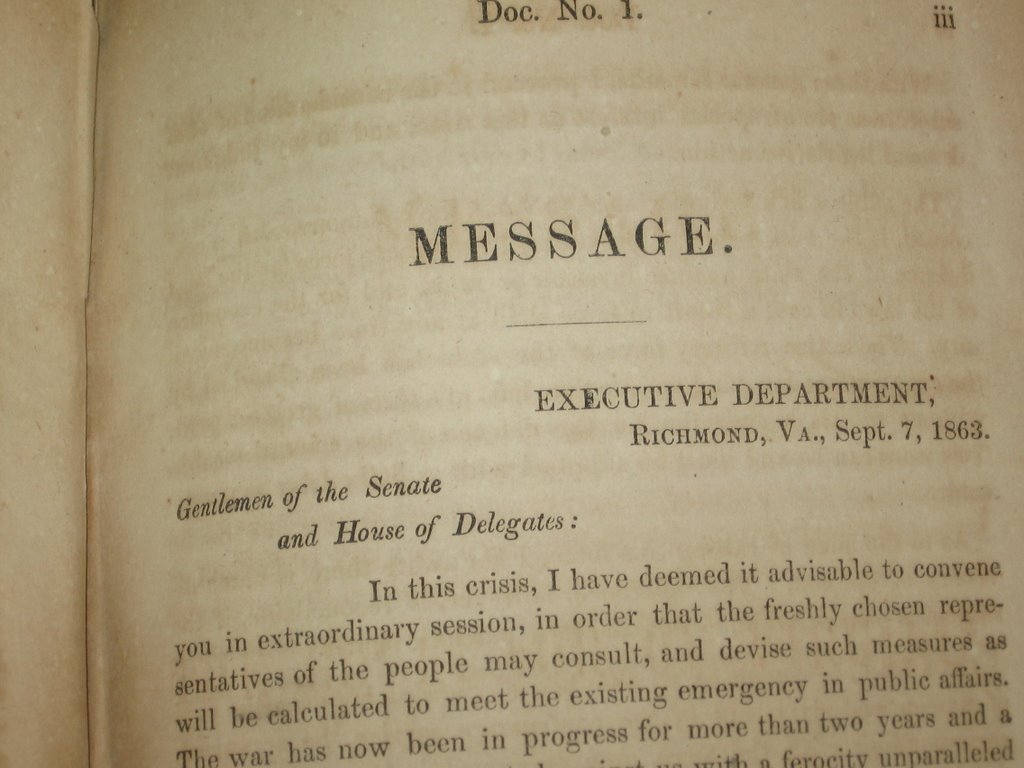
One discovery, a yellowing, cardboard-bound volume of thousands of pages of legislative and executive branch reports from 1863 contains Gov. John Letcher's order that 5,340 slaves from across the state be used to dig fortifications around Richmond, the Confederate capital, during the height of the Civil War.

It documents that the Virginia Military Institute consumed 5,250 pounds of bacon and just three-fourths of a pound of tea in June of 1863. And salt - then the primary preservative of food - was so scarce the Joint Legislative Committee on Salt decreed that the mineral be rationed: 30 pounds per year for each man, woman and child in Virginia.

Construction workers discovered the book and other documents behind ceiling tiles in what had been the governor's third-floor suite of offices.

"As they were taking down the ceilings, the book fell with it," Sliwoski said.


Another report breaks down by gender the causes of insanity for scores of people committed to the state asylum over two years. One man was committed for "fever and loss of law suit," two men and one woman for love, one man and three women for jealousy and 11 men and three women for "pecuniary troubles."
 

To tie histories together, consider this:

At the same time the boys attending VMI were consuming all that bacon in June of 1863, and the legislature was duly making note of it in the documents discovered these many years later in 2006, Captain Pichegru Woolfolk was driving his Ashland (Virginia) Artillery battery toward a tiny town in Pennsylvania called Gettysburg. It was there only days later, during the assault on Little Round Top on July 2 that Capt. Woolfolk (after scheduling a duel with another member of Lee's artillery the same morning!) sustained a wound that put him out of the war - at least temporarily.

I was reminded of this bit of history - and trivia - when I read the line in the AP story, "As they were taking down the ceilings, the book fell with it ...," for this reason:

Captain Pichegru Woolfolk survived the war and was working in the Capitol building in Richmond one day in 1870 when, according to Harry W. Pfanz in his classic Gettysburg, The Second Day, the "ceiling in a chamber of Virginia's capitol fell, crushing him beneath it."

Gettysburg. Ashland Artillery. Tragic death. Renovation. Treasure. History.

Monday, May 01, 2006

The Upside To High Oil Prices

I read a forlorn message on a community bulletin board the other day from someone in Dickenson County (Virginia). He was essentially conveying his belief that the economy in Dickenson is on the decline because his Southwest Virginia county is isolated from the rest of the country and employers wouldn't want to relocate to an area so far removed from our urban marketplaces.

My thought when I read that was, "So how is it companies in the jungles of Honduras are doing so well?"

We need to talk ...

Dear reader:

1) What was Virginia's number 2 export in 2004?

- Answer: Wood 


2) Where was much of that wood shipped?

- Answer: China 


3) What was the number 4 import to the USA from China in 2005?

- Answer: Furniture 


The number 9 export from the USA to China in 2005 was cotton. The number 5 import from China to the USA in the same year was apparel.

Did you know that most of the shoes being purchased here in the USA are made in China (particularly if they're made of leather)? A full 53% of the world's total shoe production resides there. 


So where do the Chinese get their raw leather? In part, it comes from cattle ranches here in the USA.

So what is my point?

Actually I have two:

First - If we can cut down a tree in Dickenson County, haul it to a port, put it on a boat, ship it to China, have it processed into furniture, package it, truck the finished product to a port, put it on a boat, ship it to Newark, put it on a train to an inland warehouse, truck it to the Big Stone Gap Wal-Mart where it will be sold at some every-day low price, by comparison just how remote is Dickenson County? In this case, it's a heck of a lot closer than the point of manufacture.

This leads to the obvious question: Why can't the raw material be processed right here in Southwest Virginia - as it had been for many decades?

Second - how much fuel is consumed in that process? Trucks, trucks, trains, ships, trains, processing, trucks, trains, ships, trains, trucks, forklifts, trucks ...

With the ever-rising cost of fuel, the likelihood of cotton and wood and leather being shipped half way around the world and apparel and shoes and furniture being sent back becomes ever more cost-prohibitive.

Which means - believe it or not - there is an upside to the staggering prices we're all dealing with at the pump. Removing taxes from the equation (the Chinese don't pay Governor Kaine's taxes), it will become more and more attractive for manufacturers to locate their plants here as the cost of transporting goods climbs.

Dickenson County by God, Virginia - if it plays its cards right - can reap the harvest.

Strange as it may sound, you should cheer when oil hits $100 a barrel. Before, that is, you pull up at the pump ...

Monday, April 10, 2006

I'm Famous Where?

I wake up this morning, stumble into the den with a cup of coffee, fire up the computer, check to see about the traffic that the weblog generated yesterday, and ... found out I'm being read in Mumbai.

What?

Where?

After a 30 second google search, I came to realize that Mumbai is what Bombay, India is now called (if memory serves, the British colonial name was changed because, well, it was British and the Indians still hate the British for what the latter did in the days of the Raj).

It's odd to see one of my weblog postings featured in a newspaper (Mumbai News) half way around the world. But such is life on this planet today. Welcome to the internet.

To all of my new friends in Mumbai: Namaste. Aap kaise ho? Shukriya.

And if you see my good friend, Nagabushanam Jasti, tell him to write. (Hey, it could happen. India only has 1.1 billion people).

For those of you who are interested, here's the link:

http://www.mumbaimirror.com/nmirror/mmpaper.asp?sectid=14&articleid=49200622315275049200622301931

My guess is the link won't be good for long.

The world gets smaller every day.

Update April 10 5:33pm: As I expected, the link wasn't good for long. My fifteen minutes of fame (in India) lasted ... well, about 15 minutes.

Sunday, April 09, 2006

The Persimmon Tree

When we were young, I and my two brothers, Steve and Randy, occupied our time by causing mayhem and looking for adventure. We didn't do it so as to cause our parents anguish or embarrassment or economic ruin. We just wanted to have fun. And sometimes our fun was ... misunderstood.

Like the time we invaded a neighbor's apple orchard and harvested the entire crop of his most delicious Granny Smith apples. It took us several days of climbing and picking and eating but we were thorough in our destruction. By the time we were done, the orchard was devastated. I remember we even took some of the apples home and ran them through our mother's orange squeezer and accumulated a couple of gallons of apple cider - that we let ferment for several months. Was it ever powerful. I attribute the hair on my chest to that batch of devil's brew.

Or the time we all got whippin's for throwing burning newspapers into the crawlspace of a neighbor's home. It was innocent fun - I swear.

I think we all got whippin's too for having bent the metal frame of one of our beds in two by jumping on it - something that could have been categorized as being nothing more than boys doing what boys have done throughout time immemorial - but never got whippin's for.

Then there was the time Steve, who is three years older than me and, at the time, had me by twenty pounds, was chasing me with the intention of inflicting great bodily harm. I ran up to the back gate and, because it was latched and I was hurtling at full speed, I slammed against it and knocked my front tooth out. Off to the dentist we went.

Then there was the time that Randy locked me out of the house. I got mad and ran my fist through the door glass - and sliced my wrist in the process. Off to the doctor's office we went.

And there were the normal "boys will be boys" stuff, like the time we were playing baseball in the side yard and I proceeded to put a smokin' line drive through the neighbor's window (steroids played no part in it either; it was all talent, power, and perfect follow-through). I was going to keep the shattered window a secret (yes, it was in the neighbor's living room so they might have eventually noticed the shards of glass all over the furniture) but Dad made me go over and apologize - a humbling experience. Oh, and I got a whippin'. Oh, and off to the hardware store we went to get a new window pane and spackling.

And there was the time that Randy was slugged just above the eye socket with a baseball bat by a neighbor kid. Randy has been nearly blind in that eye ever since. As I recall, Mom whisked him off to the doctor's office that day too. Worst of all, we lost our best pitcher.

We put the doctor into a six figure income in those days. Steve breaking his arm. Me jumping barefoot on a broken coke bottle. Remember the old metal coffee cans and the key you had to use to unseal them? Remember too how, when opened, the edge of the can became extremely sharp? Yep - another trip to the doctor' office for stitches.

Bee stings. Bike wrecks. Rock fights. Fist fights. Food fights. Frightening the neighbors in the dark of night. Tormenting the bejeebers out of our younger sister Suellen - who has loved and adored us throughout the years, in spite of it - oddly. The usual stuff.

I brought a snake into the house once to show everyone. Grandma let out a scream and she and Mom started squalling for me to get out! Get out! It was a relatively small one really. And it wasn't venomous, as best I could tell. Nice looking little rascal too.

Lots of whippin's were meted out as a result of much of this. Such was the nature of our youth. We arose, ate, got in trouble, got whippin's, ate, and went to bed. Every day for years.

I wouldn't give any one of those days back. They resulted in so many fond memories.

Our parents knew about all these incidents, as best I can recall, and they responded to each in their usual parental way...

But there is one story that we've never revealed. It has to do The Persimmon Tree.

Our grandparents lived along a highway out in the country. Next to their rather long driveway they had this really nice, mature persimmon tree. I was never much for persimmon pie or persimmon pudding or persimmon cake but I always appreciated the persimmon for its throwing attributes. Unlike a tomato that was too mooshy and therefore didn't allow for much distance, or an apple which didn't splatter upon impact, a persimmon, when its at its ripened peak, with its gooey innards and tough outer skin, made for the perfect missile.

One night the family had gone out to visit the grandparents. After being there for a few hours, with Mom and Dad and Suellen inside, Steve and Randy and I went out - to do what boys do. We looked for some innocent fun to occupy our time. When we got down to the persimmon tree, we came up with an idea (actually I think Steve came up with it; he usually dreamt up the schemes that got us in trouble).

We decided to throw persimmons at passing cars.

Now picture the moment. It was pitch black outside. Middle of summer. Nice warm evening. There was to the west a hill over which the cars came, doing about fifty. They'd streak past the house and disappear into the night. We'd see them for no more than fifteen seconds.

We prepared. We gathered up the juiciest, plumpest of the persimmons for ammunition and waited. Now the goal was to hit the windshield. The trick was to do it without getting our asses kicked by angry drivers. So we devised the method of launching the persimmons at such a time and with such a trajectory as to gain maximum hang-time - and time to run and hide.

We began. We could hear the cars approaching before we even saw the headlights. We then saw the twin beams appear over the rise and the three of us, in syncronization the likes of which Hannibal would have appreciated at the Battle of Cannae, threw our persimmons high into the air - and took off running.

It took us a number of practice cars to get the range, timing and trajectory down pat but when we did, the resulting mayhem was something to behold. The sound a persimmon makes when it hits a windshield on a car doing fifty resembles that of a 3 wood hitting a golf ball that's been retrieved from the bottom of a water hazard. A kind of thud sound with a touch of ping.

Because light travels faster than sound, we'd sometimes see the brake lights come on before we heard the splat. But that was only in those instances where we were fast enough to gain our hiding place in time.

What we weren't able to witness was the product of our efforts. The goo on the windshields. The enraged drivers.

We hid. In total darkness. No sound except for the summer nightbugs. Only a person with superhuman hearing could have discerned the faint distant giggles of young boys celebrating their mission accomplished.

All this happened many years ago. Steve and Randy and I have until now kept The Persimmon Tree our secret. It was only a few years later it seems that Steve was off in Vietnam and Randy was in the Air Force and I was chasing Paula around the college campus. We'd all gone our separate ways - forever. Of course there was Suellen, tugging at us all to try to keep the family together as much as was possible.

Dad and Grandpa and Grandma - and the persimmon tree - are long gone now.

What lingers though is a memory of a glorious night together, having fun doing what boys do.

Thursday, March 30, 2006

On The Road

I come to you from College Park, Maryland this morning. I'm on the University of Maryland campus. A more beautiful conglomeration of buildings you'll never see - except perhaps at UVA - or Washington & Lee - or Emory & Henry. But with those possible exceptions, UM is a fine looking facility - in a lousy urban setting.

Monday, March 20, 2006

From The Mailbag

I received this from an area resident today.

Mr Fuhrman,

I just wanted to drop you a note and tell you how much I enjoy your blog. I visit every day, often several times a day. Your focus and what you say about that focus on the sad state of affairs in southwest Virginia mirror my own. I'm a life-long resident
of Dickenson County and ...


Why so many residents of this area and congressional district don't get it is beyond my comprehension. Boucher is a God to the vast majority of people in Dickenson County yet we're in a lot worse shape now than when he was first elected. I could go on and on but I know you get the picture and already know where I would end up if I did continue. It's a old story--just like the ones you so often blog about.

Keep up the good work in pointing out that we're all dying on the vine.


Name withheld
Party politics is a strange beast. The most economically depressed counties in all of Virginia (I've not done an exhaustive study) are probably Dickenson, Tazewell, and Russell. And all have voted heavily for Rick Boucher and the Democratic slate over the years. Amazing.

Tradition is a great thing. And the Democratic Party's relationship with the people in these communities goes way back. But way back doesn't put food on the table or a paycheck in the bank. We here in Bland voted our (Democratic) bum out in the most recent House of Delegates election and sent a message that conditions must change. Or we'll have no communities.

Thanks to the reader for the kind words and for being the (seemingly) lone voice calling for change in all of Dickenson County, Virginia.

Always Misunderestimating

A joke to get your week going:

Dick Cheney and George W. Bush were having breakfast at the White House.

The attractive waitress asks Cheney what he would like, and he replies,"I'd like a bowl of oatmeal and some fruit."

"And what can I get for you, Mr. President?"

George W. replies with his trademark wink and slight grin, "How about a quickie this morning?"

"Why, Mr. President!" the waitress exclaims "How rude! You're starting to act like Mr. Clinton, and you've only been in your second term of office for a year!"

As the waitress storms away, Cheney leans over to Bush and whispers ... "It's pronounced 'quiche'."

Wednesday, March 15, 2006

All In A Day's Work

A Prayer For Our Firefighters

Thank you Lord for those whose Hearts
Are generous and Brave
So generous, they risk their Lives
That others may be Saved

Thank you Lord for those who Choose
To serve those in Distress
Please grant them Strength, exactly When,
They think there’s nothing Left

Thank you Lord for those who Know,
That life is short and Dear
May you always help them Be,
The Masters of their Fear
Thank you Lord for those who Risk,

To feel another’s Pain
Help them, as they daily Face,
What most would deem Insane

Thank you Lord for those who Ask,
To live a “Bigger Life”
Embracing all the lessons learned,
In Struggle and in Strife

May they always have the Will,
To choose the “Higher Road”
Grant strength to those who choose to Share,
Their Journey and their Load

And may the rest of us be Grateful,
That our world is made much Brighter,
Illuminated by the Souls
Of Our Firefighters

Author: Ann Fairbanks

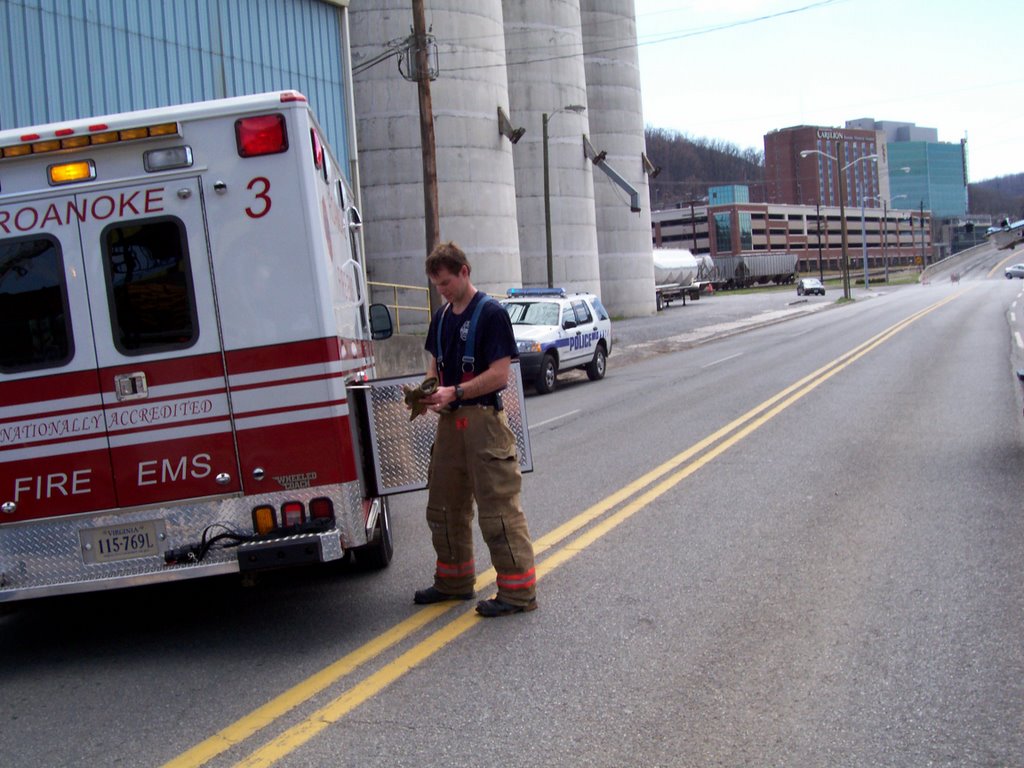
The photos above are of firefighter Jarrod Fuhrman, Engine 3, Roanoke Fire/EMS, Saturday, March 11, 2006, responding to the Carilion Biomedical Institute fire in downtown Roanoke.


Click on images to enlarge.

Wednesday, March 08, 2006

Kaid & Jayla's Excellent Adventure

Think of all the adventures that lie ahead.

Among the many (fourth) birthday gifts Paula and I heaped upon the twins last week were two new bicycles. Although it wasn't quite warm enough this past weekend to be out in short sleeves (ahem!), it was warm enough for Kaid and Jayla to take their first bike lesson ever.

This week they conquered the bike. Tomorrow a cure for cancer. A walk on Mars. Raising families of their own.

Such wonders.

Thursday, February 23, 2006

Back To The Future

The first rule in my world is: Strive to improve your performance each and every day or some teenager is going to come along, show you how it's done, and take your place.

And, as I've often said, just when you think you have it all figured out, when you're confident that you're at the top of your game, when you are dead-certain that you're the master of your universe, that you have all the answers, somebody comes along and changes all the questions.

With that in mind, and out of this relentless pursuit of self-preservation, I've gone back to school. At least for two days (today and tomorrow) I'm in learning mode. You'll find me in Greensboro, North Carolina.

So much to learn and there's so little time. And so many teenagers ...

Tuesday, February 21, 2006

I'm In Big Trouble

When I wrote the following yesterday, I was trying to be funny:
"For the record, I do not endorse the slaughter and consumption of dogs. Cats, on the other hand ..."
I received an email this morning from Paula. She seems to be put out with me for suggesting that I might ever kill her cats and eat them. She advised that she will be doing a daily headcount (a two hour process - don't ask) and if any turn up missing, I'm in big trouble.

Note to Paula: I love you. You know that. And I would never eat your cats. As for laboratory experiments, on the other hand ...

Just kidding. Just kidding.

Saturday, February 18, 2006

The Pickle Jar

A story:

The pickle jar as far back as I can remember sat on the floor beside the dresser in my parents' bedroom. When he got ready for bed, Dad would empty his pockets and toss his coins into the jar.

As a small boy I was always fascinated at the sounds the coins made as they were dropped into the jar. They landed with a merry jingle when the jar was almost empty. Then the tones gradually muted to a dull thud as the jar was filled.

I used to squat on the floor in front of the jar and admire the copper and silver circles that glinted like a pirate's treasure when the sun poured through the bedroom window.

When the jar was filled, Dad would sit at the kitchen table and roll the coins before taking them to the bank.

Taking the coins to the bank was always a big production. Stacked neatly in a small cardboard box, the coins were placed between Dad and me on the seat of his old truck.

Each and every time, as we drove to the bank, Dad would look at me hopefully. "Those coins are going to keep you out of the textile mill, son. You're going to do better than me. This old mill town's not going to hold you back."

Also, each and every time, as he slid the box of rolled coins across the counter at the bank toward the cashier, he would grin proudly "These are for my son's college fund. He'll never work at the mill all his life like me."

We would always celebrate each deposit by stopping for an ice cream cone. I always got chocolate. Dad always got vanilla. When the clerk at the ice cream parlor handed Dad his change, he would show me the few coins nestled in his palm. "When we get home, we'll start filling the jar again."

He always let me drop the first coins into the empty jar. As they rattled around with a brief, happy jingle, we grinned at each other. "You'll get to college on pennies, nickels, dimes and quarters," he said. "But you'll get there. I'll see to that."

The years passed, and I finished college and took a job in another town.

Once, while visiting my parents, I used the phone in their bedroom, and noticed that the pickle jar was gone. It had served its purpose and had been removed.

A lump rose in my throat as I stared at the spot beside the dresser where the jar had always stood. My dad was a man of few words, and never lectured me on the values of determination, perseverance, and faith. The pickle jar had taught me all these virtues far more eloquently than the most flowery of words could have done.

When I married, I told my wife Susan about the significant part the lowly pickle jar had played in my life as a boy. In my mind, it defined, more than anything else, how much my dad had loved me. No matter how rough things got at home, Dad continued to doggedly drop his coins into the jar. Even the summer when Dad got laid off from the mill, and Mama had to serve dried beans several times a week, not a single dime was taken from the jar. To the contrary, as Dad looked across the table at me, pouring catsup over my beans to make them more palatable, he became more determined than ever to make a way out for me. "When you finish college, Son," he told me, his eyes glistening, "You'll never have to eat beans again - unless you want to."

The first Christmas after our daughter Jessica was born, we spent the holiday with my parents. After dinner, Mom and Dad sat next to each other on the sofa, taking turns cuddling their first grandchild. Jessica began to whimper softly, and Susan took her from Dad's arms. She probably needs to be changed," she said, carrying the baby into my parents' bedroom to diaper her. When Susan came back into the living room, there was a strange mist in her eyes.


She handed Jessica back to Dad before taking my hand and leading me into the room. "Look," she said softly, her eyes directing me to a spot on the floor beside the dresser. To my amazement, there, as if it had never been removed, stood the old pickle jar, the bottom already covered with coins. I walked over to the pickle jar, dug down into my pocket, and pulled out a fistful of coins. With a gamut of emotions choking me, I dropped the coins into the jar. I looked up and saw that Dad, carrying Jessica, had slipped quietly into the room. Our eyes locked, and I knew he was feeling the same emotions I felt. Neither one of us could speak.

A gift - one of many - passed down from generation to generation.

Author unknown

Wednesday, January 25, 2006

The Windy City?

I come to you this morning from the seventh floor of the Crowne Plaza Hotel in Columbus, Ohio. I'm in bed cowering beneath the covers, waiting for the windows to implode. The wind gusts are fierce.

I've been here for several days and look forward to heading home this evening. If I don't get blown into Oklahoma in the attempt, that is.

See y'all soon.